
Vernon County Genealogy Records
Vernon County Genealogy research has a good mix of courthouse records, historical society microfiche, and regional archive support. The county Register of Deeds gives you birth, marriage, death, and land records that begin in the mid-1800s, while the historical society keeps older local copies and later microfiche sets that help bridge gaps. That makes Vernon County especially useful for family lines that started early and then stayed in the region for a long stretch. If you need a clean path from a county deed to a birth or marriage clue, Vernon County has enough record layers to keep the search moving.
Vernon County Genealogy Records
The Vernon County Register of Deeds is at 400 Courthouse Square, Room 110, Viroqua, WI 54665. The phone number is (608) 637-5371 and the fax number is (608) 637-5304. For Vernon County Genealogy, the office is the main stop for birth records from 1863, marriage records from 1855, death records from 1878, and land records from 1851. Those starting years are important because Vernon County's county-level paper trail reaches back well before many families expect. A search that begins with one of those dates often saves time and points you to the right book or copy request on the first try.
The county also provides certified copies, and the official county site supports online ordering through its approved path. That matters when you need a legal copy for a file, not just a research note. In Vernon County Genealogy work, the office is often where a land question turns into a family question. A deed can lead to a marriage year. A marriage year can lead to a birth search. Starting at the courthouse keeps the whole line tied to the county record instead of to a guess from a secondary source.
You can begin at the county site itself at vernoncounty.org and move from there to the record request path that fits your needs. That is useful when you need to confirm whether a copy can be ordered online or whether the file will need a direct office request. Vernon County Genealogy often rewards that simple first step because the county has enough early coverage to make a direct search worthwhile.
The Vernon County Historical Society image on the manifest links back to the society website.
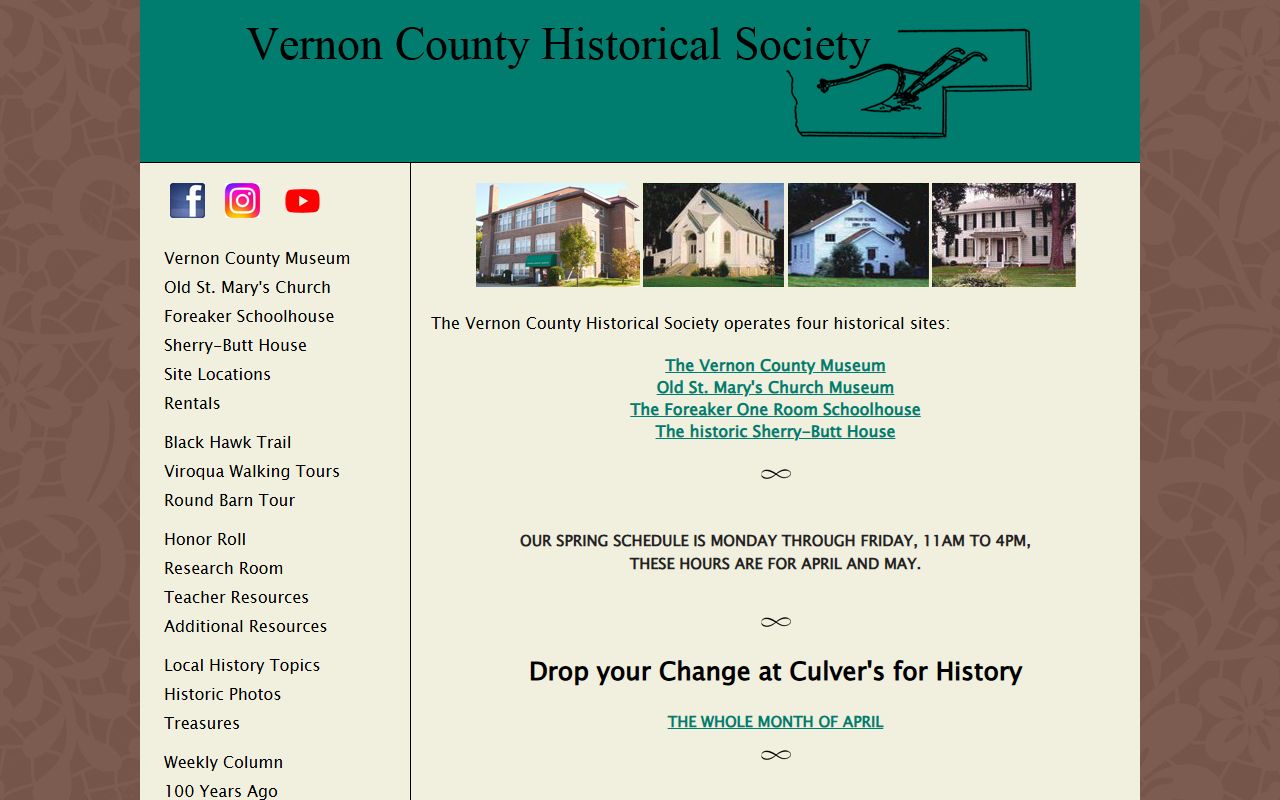
That image is a good match because the historical society fills in the county story with older family material and microfiche sets that complement the courthouse files.
Vernon County Genealogy Historical Society
The Vernon County Historical Society is in Viroqua and has a research room at the museum that is unusually useful for family history work. Its holdings include 1850s Bad Ax County marriage certificates, 1850s to 1870s birth certifications from Bad Ax and Vernon County, 1876 to 1886 death record information, and pre-1907 Wisconsin births, marriages, and deaths on microfiche. That gives Vernon County Genealogy a rare mix of very early local material and broad Wisconsin coverage in one place.
The later microfiche sets are just as useful when a family line extends into the mid-20th century. The society also holds Wisconsin death microfiche for 1959 to 1967, 1969 to 1970, and 1979 to 1984, plus Wisconsin divorce microfiche for 1965 to 1984 and marriage microfiche for 1973 to 1984. Those sets matter because a family may have a county birth or marriage in the 1850s and then a later death or divorce that only appears in the society's files. For Vernon County Genealogy, that kind of layered coverage is a real advantage.
When you combine the historical society with the county office, you can move from a deed or certificate into the wider family line without losing the local place name. That is especially important for Vernon County because older family records often shift between Bad Ax and Vernon references. The historical society keeps those labels connected, which makes the search easier to read and easier to trust.
Vernon County Genealogy and Archives
The best regional archive support for Vernon County Genealogy is the UW-La Crosse Murphy Library / La Crosse Area Research Center. It serves Vernon County and holds pre-1907 vital records, probate cases, deed records, naturalization papers, and tax rolls. The archive also covers Jackson, La Crosse, Monroe, and Trempealeau counties, so it is built for family lines that cross a county border. If the county office gives you the record, the archive can often give you the context around it.
The La Crosse area center is one of the Wisconsin Historical Society's regional depositories, and its collection size makes a difference. It has more than 1,000 linear feet of public records and manuscript collections, along with 450 reels of microfilm. For Vernon County Genealogy, that means older public records do not disappear when they leave the courthouse. They stay in a place where researchers can compare deeds, probate files, and naturalization papers side by side. That is often the fastest way to make sense of a family's movement in and out of a township.
Statewide tools help round out the Vernon County picture. The Wisconsin Historical Society pre-1907 vital records collection is useful when a county record needs a second source. The BLM General Land Office Records can also help if a family first entered land through a federal patent. For later state records, the Wisconsin Department of Health Services Vital Records Office is the right place for post-1907 material, and Wisconsin Circuit Court Access can help with later court checks. That mix gives Vernon County Genealogy a clear path from local to state.
Vernon County Genealogy Help
The Wisconsin State Genealogical Society is a useful statewide layer when Vernon County Genealogy research needs a county guide or a local society connection. A statewide Wisconsin genealogy guide is also worth checking because it outlines state birth, marriage, death, probate, naturalization, and census collections in one place. Those resources are not a substitute for the county office or the historical society, but they can shorten the time it takes to confirm where a record should be.
The Wisconsin State Law Library helps when a request turns into a question about probate access, public records, or record fees. The Library of Congress Wisconsin local history and genealogy guide is also useful because it shows the county-to-state shift for the major vital record types. That makes it easier to tell when Vernon County Genealogy should stay local and when the search should move to a state file. A search that respects that line is usually faster and more accurate.
Because Vernon County has a strong mix of early records and later microfiche, it helps to check more than one source before you stop. The county office, the historical society, and the La Crosse archive each hold a different piece of the same family story. When they agree, you have a much stronger answer. When they do not, you know exactly where to look next.
Note: Vernon County Genealogy research often moves faster when the museum microfiche, county copy, and La Crosse archive all point to the same family line.
Vernon County Genealogy Next Steps
Begin with the earliest date you know and match it to the right record type. For Vernon County Genealogy, that can mean a marriage year from 1855, a land date from 1851, or a birth or death clue from the later county files. Once you have the year range, compare the county record with the historical society microfiche and the La Crosse archive. That three-part check often resolves place names, family branches, and spelling differences in one pass.
If the county copy is enough, order the certified copy and keep moving. If it is not, use the society and archive together before you move to state records. That keeps the search local for as long as possible and helps you avoid overreaching into statewide collections too soon. Vernon County Genealogy is strongest when the local courthouse, the museum research room, and the regional archive are used as a team.