
Find Rusk County Genealogy
Rusk County Genealogy searches are built around a practical mix of county records and local history clues. The Register of Deeds keeps birth, death, and marriage records from 1863 to the present, along with a cemetery index, grantor and grantee indexes for real estate, some plat books from 1914 to the present, the Rusk County Atlas of 1914, and a 1905 census reference. That gives family researchers a useful path from a single surname to a place on the land. The county museum also adds local memory, which helps when a family name appears in a deed but needs a town, church, or burial setting to make sense.
Rusk County Genealogy Records
The Rusk County Register of Deeds is the main office for Rusk County Genealogy work. It is at 311 Miner Ave. East, Suite 132N, Ladysmith, WI 54848, with the phone number (715) 532-2139 and fax number (715) 532-2194. The office notes that birth, death, and marriage records run from 1863 to the present. It also keeps real estate grantor and grantee indexes, some plat books from 1914 to the present, and the county atlas from 1914. For a family researcher, that is a strong set because it lets you move from a vital record to a land trail without changing offices.
The office also points researchers to the Rusk County Cemetery Index and a 1905 census reference. Those details matter because Rusk County Genealogy searches are often about narrowing the line, not just finding a name. A cemetery index can confirm a burial when a death record is hard to pin down. A plat book can place a farm on the map. The 1905 census reference can help when you need a household snapshot between the late nineteenth century and the first modern county records.
If you plan to request copies, the research notes say the application must be signed and supported by proof of identity for all searches. The office also says no appointment is needed for genealogy research. Certified vital record copies are $20 for the first copy and $3 for each additional copy. That makes the office straightforward for local work, but it also rewards preparation. Bring the name, the date range, and any land clue you already have. That is usually enough to turn a broad search into a focused one.
For a Rusk County Genealogy search, the best details to carry are:
- Full names, including maiden names and spelling variants
- A likely year or a narrow date range
- A township, cemetery, or plat clue
- Any deed, parent, or spouse name tied to the family
Note: In Rusk County Genealogy work, the cemetery index and the 1905 census reference can save time when a vital record alone does not answer the question.
Rusk County Genealogy History
The Rusk County Historical Society Museum gives Rusk County Genealogy a local setting. Even though the museum research is still in progress, the museum is useful as a history stop because it anchors family names in the county story. That matters in a place where land, burial, and settlement patterns can explain why one family stayed on a road while another moved a few miles away. A name in a deed book is useful, but a museum or history room can tell you what sort of place the family entered.
Rusk County was still being built when many of its early records took shape. That means a family might show up first in land or burial material before it appears in later printed sources. The Bruce Area Historical Society, also noted in the research, gives another local history clue. It can help when a surname crosses a village line or when a branch of the family settles in a smaller community that did not leave a large paper trail. In Rusk County Genealogy, those local history contacts are not a side note. They often explain the records themselves.
This county also rewards place-based reading. If a plat book shows a farm near a cemetery, or if the atlas places a family near a road that still carries the same name, the story becomes easier to follow. That is why Rusk County Genealogy is best treated as a layered search. The deed trail shows land. The cemetery index shows memory. The museum adds local frame. Together they make the county records more useful than any single list.
Rusk County Genealogy Images
The Rusk County Register of Deeds image in the manifest comes from ruskcounty.org/deeds.
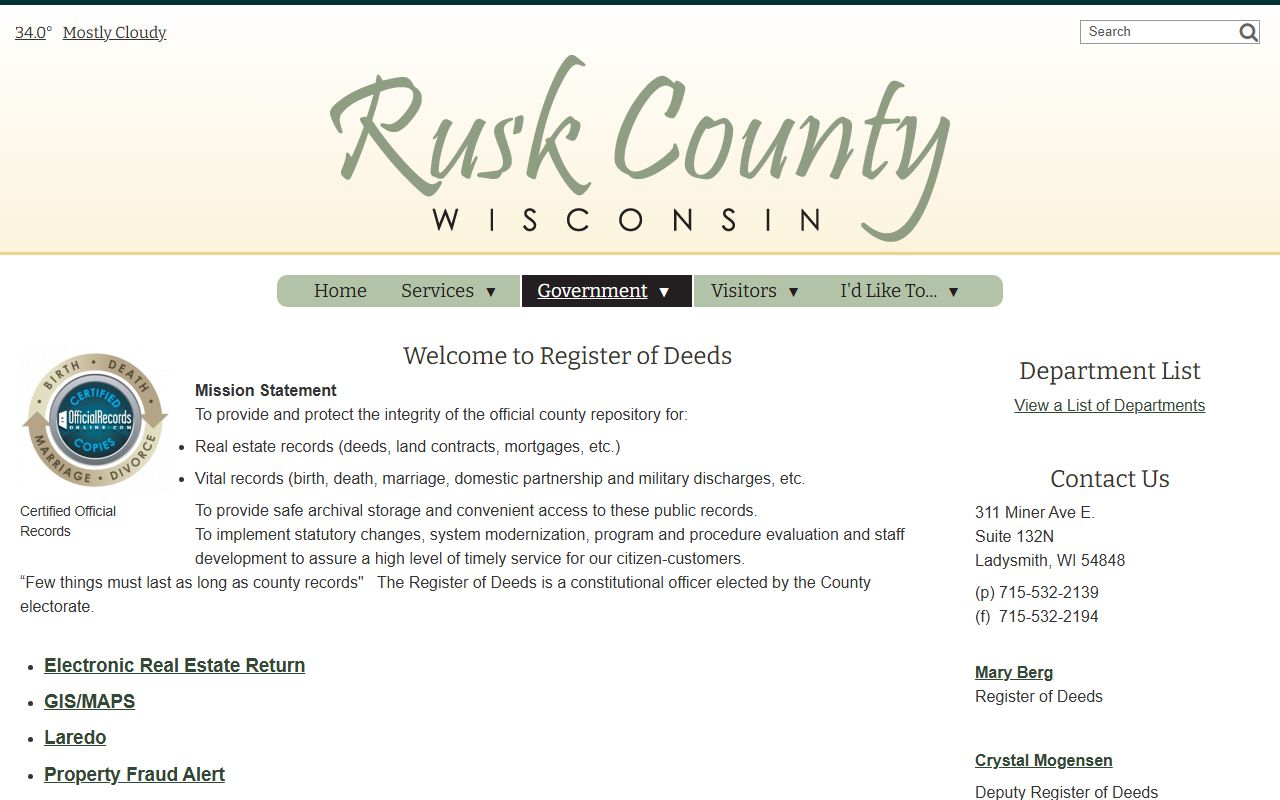
This image fits Rusk County Genealogy because the register is the county's main public doorway for vital records, land indexes, and cemetery-related research.
That image is more than decoration. It reminds a researcher that Rusk County Genealogy work starts with the office that actually keeps the county's record trail. When you are sorting between a burial clue, a deed clue, and a vital record clue, the Register of Deeds is the place that can connect the dots.
The same office is useful even when the first search does not solve the case. A signed application, a clear date range, and a few land details can usually move the search forward. In a county this size, the right record often appears after the first clue is checked twice.
Wisconsin Genealogy Support
When Rusk County Genealogy needs a broader check, the Wisconsin Historical Society is the best statewide backstop. Its pre-1907 vital records, census holdings, and older family history materials can confirm a name or a date that the county index only hints at. That is especially useful when a Rusk County family appears before statewide registration was fully enforced and the record trail is still uneven.
The Wisconsin DHS Vital Records site is another good cross-check for later records, while Wisconsin Circuit Court Access helps when a probate, civil, or other court matter is part of the family story. For older context, the BadgerLink family history resources can also help when a surname appears in a statewide index and you need a broader historical frame.
Rusk County Genealogy searches work best when the county record, the cemetery clue, and the state-level confirmation all point to the same person. That approach is simple, but it is usually the fastest way to avoid mixing up two families with the same surname.