
Oneida County Genealogy Records
Oneida County Genealogy research begins at the courthouse and stays practical from there. The Register of Deeds handles birth, death, and marriage records, along with military discharges and real estate records. It also gives researchers online access through RecordEASE Web and grantor or grantee index files. If you need a county record that can be searched without guessing, Oneida County has the kind of setup that rewards a precise name, a date range, and a clear land clue.
Oneida County Genealogy Records
The Oneida County Register of Deeds is in the Oneida County Courthouse, P.O. Box 400, 1 S. Oneida Ave., Rhinelander, WI 54501. The office phone is 715-369-6150 and the fax number is 715-369-6222. Office hours are Monday through Friday, 8:00 AM to 4:30 PM, on the second floor. Those details are useful for any Genealogy visit because they tell you when and where to go if you need to see the record trail in person.
The office records include birth, death, and marriage documents, plus military discharges and real estate records. That mix makes Oneida County Genealogy more than a vital-record lookup. It can become a land search, a service record search, or a family history check that starts with one document and ends with a property or military clue. The county also points users to RecordEASE Web and grantor or grantee index files, which gives you two ways to follow the same surname before you ever step into the courthouse.
The manifest image for Oneida County comes from the Oneida County Register of Deeds.
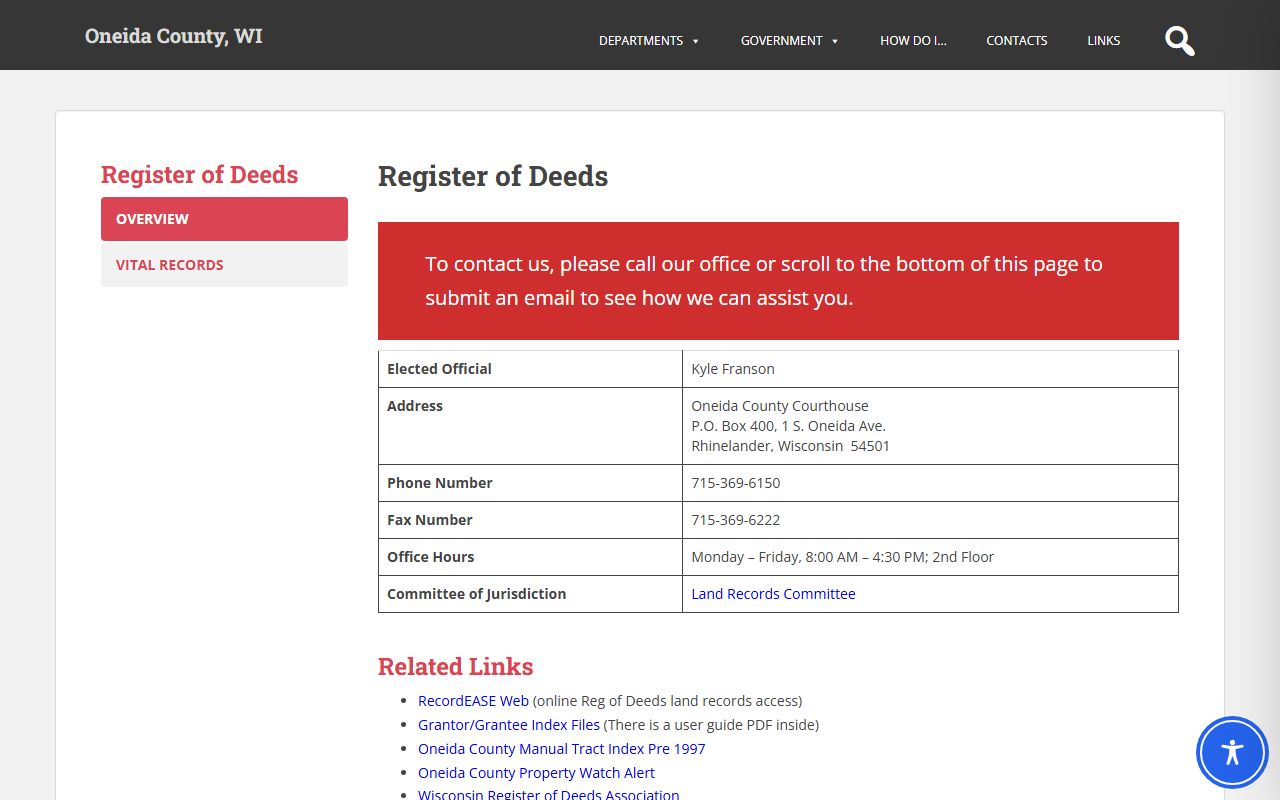
This image works well for Oneida County Genealogy because the register is the main office for the county's vital, land, and military record trail.
Oneida County Genealogy and Naturalization
Oneida County Genealogy also benefits from the local history notes gathered in the FamilySearch Oneida County wiki. The wiki says birth, marriage, and death records begin in 1887, and it notes naturalization records from 1906 to 1951 with indexes from 1891 to 1954. That is useful as a guide, not as the final word. It tells you what kind of record range to expect before you ask for a copy or compare the county index with another source.
The same research note also points to the history of Lincoln, Oneida, and Vilas counties from 1925, a source with 587 pages of biographies. That kind of local history is important because a name in a county book can explain why a family appears in one township and not another. For Oneida County Genealogy, a local history volume can be the bridge between a court or naturalization clue and a household that appears in the census or land record later on.
Oneida County Courthouse Records
RecordEASE Web is the most direct online tool mentioned for Oneida County Genealogy. It is paired with the grantor and grantee index files, so land research can move from a name search to a document trail without confusion. That matters when the family name is common or when a property transfer is the only surviving clue. A land record can show when a person arrived, sold, inherited, or moved, and the county's online tools make that kind of work much easier.
The courthouse setting also matters because Oneida County keeps records that often connect to each other. Military discharges can help identify a person by service history. Real estate records can confirm residence. Vital records can pin down family ties. When you use all four together, Oneida County Genealogy becomes a steady process instead of a guess. If the online index gives you a partial answer, the second-floor office can fill in the rest during normal weekday hours.
Oneida County Real Estate
Real estate records are a major reason Oneida County Genealogy works so well for long-term family study. A deed can show where a person lived. A mortgage or transfer can show when the household changed. A grantor or grantee index can show the order in which names moved through the record. Those details are especially useful in a county where land and family lines often overlap, because the property trail can confirm a surname even when a vital record is incomplete.
Military discharges add another layer. They can identify a man by service, unit, or discharge date and then point back to a family home in Rhinelander or a nearby township. When that clue is read alongside RecordEASE, the office index, and the courthouse hours, Oneida County Genealogy becomes much easier to manage. The county does not force you to guess. It gives you a way to work from a land clue toward a family answer.
Oneida County Genealogy Search Steps
A Oneida County Genealogy search works best when you bring enough detail to narrow the courthouse index but not so much that you miss alternate spellings. The county's online tools are good, but the strongest results still come from a clean search plan and a willingness to compare the office record with the local history record.
- Start with the full name and any spelling variation you know.
- Use an estimated year for birth, death, marriage, or discharge records.
- Keep a property clue ready for RecordEASE and the grantor or grantee index.
- Note any township, town, or neighborhood that appears in family papers.
- Use the 1925 local history book when a surname needs more context.
Those steps keep a Oneida County Genealogy search grounded in the record set the county actually offers. If the first search misses, the second often catches what the first did not. That happens most often with land files and military discharges, where one small clue can unlock a much larger paper trail.
Oneida County Family History Notes
Oneida County Genealogy is strongest when you pair the courthouse with a plain, patient reading of the local history record. The office gives you the direct sources. The wiki notes help you understand the date ranges. The old county history gives you names and places that may not be visible in a short index. Together, they make a search feel practical instead of scattered.
If you need a state-level backup, the Wisconsin Historical Society and Wisconsin DHS Vital Records are useful next steps for a broader confirmation search. They do not replace the county office, but they can help when you need a second official check or when a family moved into Oneida County from somewhere else in Wisconsin. That is often enough to close the gap between a surname and a verified record.
Oneida County also rewards anyone who pays attention to office timing. Monday through Friday hours, a second-floor location, and an online index system make the county record trail easy to approach in the right order. When Genealogy work is organized that way, Oneida County gives back quickly.
That extra step saves time.