
Oconto County Genealogy Records
Oconto County Genealogy work starts with the Register of Deeds and then expands into land and probate sources that reach beyond one office. The county keeps birth, death, and marriage certificates, and it also offers a free genealogy records search. Recorded land documents can be searched by grantor or grantee, which gives you a practical way to follow a family name through property, inheritance, and long residence. If you need to trace a line that moves between a certificate, a deed, and a probate file, Oconto County gives you a clear path to begin.
Oconto County Genealogy Records
The Oconto County Register of Deeds is at 301 Washington St., Oconto, WI 54153. The office phone is 920-834-7113 and the fax number is 920-834-6805. Those contact details matter because a Genealogy search often begins with a quick question before it becomes a copy request. The office keeps birth, death, and marriage certificates, so it is the first place to check when a family event needs a county source.
That office also offers a free genealogy records search and recorded land documents searchable by grantor or grantee. Those two tools work well together. A certificate can confirm a date. A land search can confirm the same surname on a parcel, a transfer, or a chain of ownership. When the county is trying to show you the whole family trail, Oconto County Genealogy becomes stronger because the office gives you both the vital record side and the land side of the search.
Oconto County Genealogy at UW-Green Bay
The county also ties into a wider archive network through the UW-Green Bay Area Research Center. That center serves an 11-county region and holds Oconto-related materials that can fill in gaps when the local office record is thin or when a family line crosses county borders. For Oconto County Genealogy, that matters because a deed, will, or court file can point you to a nearby county as easily as to a local office.
The manifest image for Oconto County comes from the UW-Green Bay Archives genealogy collection.
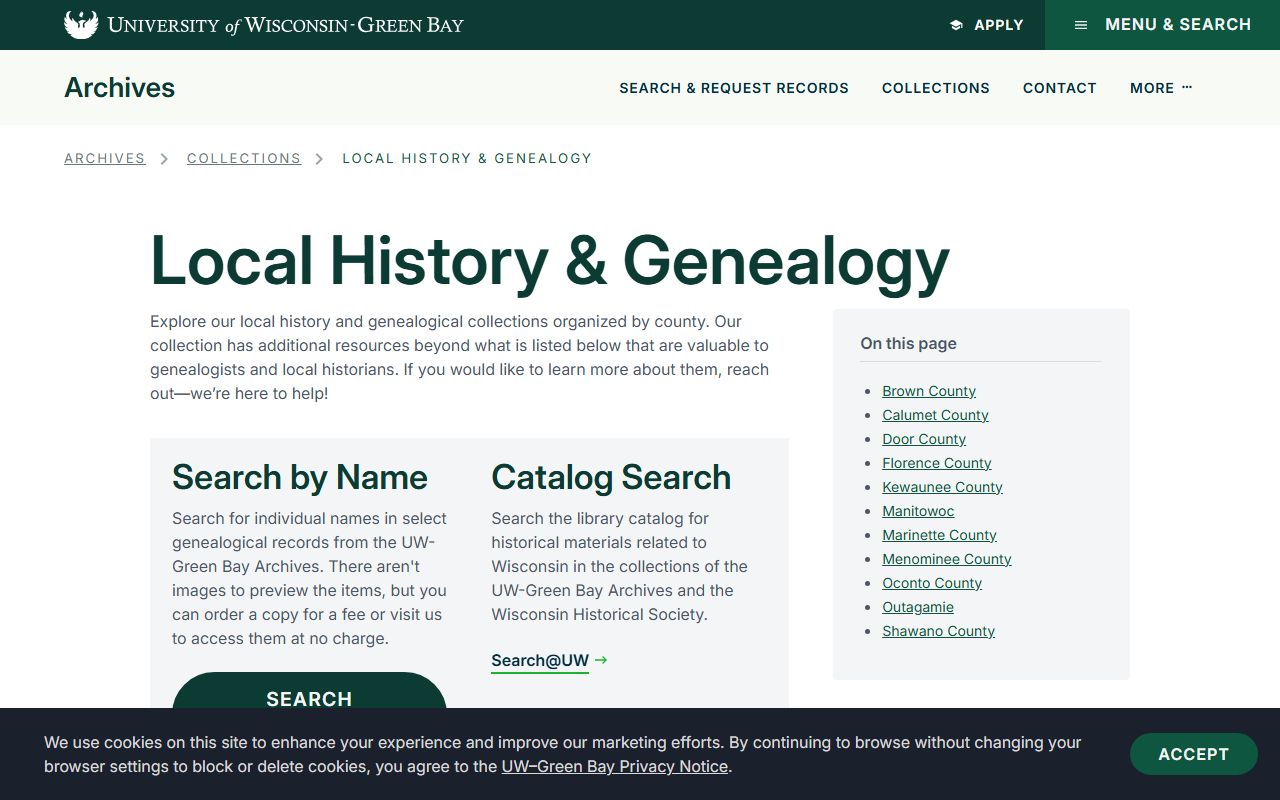
This image fits Oconto County Genealogy because the regional archive is where probate work can grow from a county clue into a broader family story.
The research note that matters most here is the probate coverage. The UW-Green Bay center lists wills and probate case files from 1857 to 1952. That span is long enough to cover many families that first appear in a land search, a death notice, or an old estate reference. If a name appears in the Register of Deeds but not in the vital books, the archive can still give the line shape and context.
Oconto County Genealogy Search Steps
A careful Oconto County Genealogy search works best when you move from the narrow record to the wider one. Start with the office that names the event, then check the land trail, then widen out to probate and regional holdings. That order keeps you from jumping too fast to a record that only sounds right.
- Use the full name and any known spelling variants.
- Match the birth, death, or marriage event to the right office record.
- Check grantor and grantee names for land transfers tied to the same family.
- Compare probate dates with the 1857 to 1952 UW-Green Bay case files.
- Keep a note of town, township, or nearby county clues for follow-up.
Those steps matter because Oconto County Genealogy records are strong, but they are not all in one place. A deed can hint at a residence. A certificate can give the event date. A probate file can connect heirs. When you line them up, the county record trail starts to read like a single story instead of three separate searches.
Oconto County Land Documents
Land work is one of the best ways to stretch Oconto County Genealogy beyond a single certificate. Because recorded land documents are searchable by grantor or grantee, you can follow a person who bought, sold, inherited, or passed land to the next generation. That is useful when a family stayed in the county for years and left a small but steady paper trail. It is also useful when the same name appears in several townships, because the land search can tell you which reference belongs to the right household.
The county's free genealogy search and land document access work best when they are used together. A birth or marriage record can put a person in the right decade. A land entry can place that same person on a road, a lot, or a farm. The result is a better county Genealogy search because the record stops being just a name and becomes a place with a date and a reason for the move. That is the kind of detail that often turns up in Oconto County before it turns up anywhere else.
Oconto County Family History Notes
Oconto County Genealogy is easiest to finish when you treat the county office and the regional archive as partners. The Register of Deeds handles the direct record request side, while the UW-Green Bay Area Research Center helps with older probate material and broader context. That is especially useful when a family appears in one record type but not another. A family may show up in land work first, then in a probate packet, and only later in a birth or marriage certificate.
If the county record trail stalls, state support can help you confirm the basics before you widen the search again. The Wisconsin Historical Society can add local history depth, BadgerLink can help with newspaper and research access, and the Wisconsin DHS Vital Records page is a useful backup when you need another official path for a birth, death, or marriage search. For Oconto County Genealogy, those state tools are best used as support, not as a replacement for the county record.
That balance is usually enough. Use the county office first. Use the archive when the case is older or more complex. Then use state tools if the family moved, the record is missing, or you need one more check before you stop.
Oconto County Genealogy also improves when you keep the local geography in view. Families often move along roads, shorelines, or timber routes, and those moves can show up in the land record before they show up in a later census or obituary. If you know the township or a nearby neighbor, the grantor and grantee search becomes much more useful because it can separate one line from another. That kind of small clue can save a great deal of time.
When the record is still unclear, go back to the county office notes and compare them with the archive range. A death certificate may point to a spouse. A deed may point to an heir. A probate file may point to a child who stayed in the county while the rest of the family moved away. Those connections are what make Oconto County Genealogy worth the extra care.