
Columbia County Genealogy Records
Columbia County genealogy work starts with the county office in Portage and grows best when you use local history and state research tools together. The Register of Deeds holds a long run of vital and land material, so you can follow a family from early county settlement into later property and record work. That makes Columbia County a useful place for tracing house sites, marriage lines, and old family moves along the Wisconsin River corridor. If one source gives you a name and another gives you a place, the county usually has enough depth to connect the two.
Columbia County Genealogy Overview
Columbia County Genealogy Records
The Columbia County Register of Deeds is at 400 DeWitt Street in Portage, with a mailing address at P.O. Box 133. The office keeps birth records from 1860, marriage records from 1849, death records from 1877, and land records from 1829. Those dates make Columbia County useful for both family and property work. A birth record can point to parents. A marriage entry can fix a surname change. A land record can show where the family lived, bought, sold, or passed property to the next generation.
Fees are clear too. Columbia County charges $20 per certified copy, and real estate documents are $2 for the first page, $1 for each additional page, and $1 for certification. That fee structure matters when you are planning a research trip or mailing a request. If you know in advance whether you need one record or several, you can keep the search tight and avoid extra cost. It also helps when you are checking whether a family line belongs to one exact township or to a wider county cluster.
For broader research, the county works well with the UW-Green Bay Archives and Area Research Center. The ARC network gives Columbia County researchers another place to look when a family shows up in land, probate, or older county records that are not easy to read in one office visit. The Wisconsin State Genealogical Society - Columbia County page is also useful because it keeps the search tied to the county name instead of making you guess where to start.
Columbia County Record Images
The Columbia County WSGS image in the manifest links back to wsgs.org/columbia.
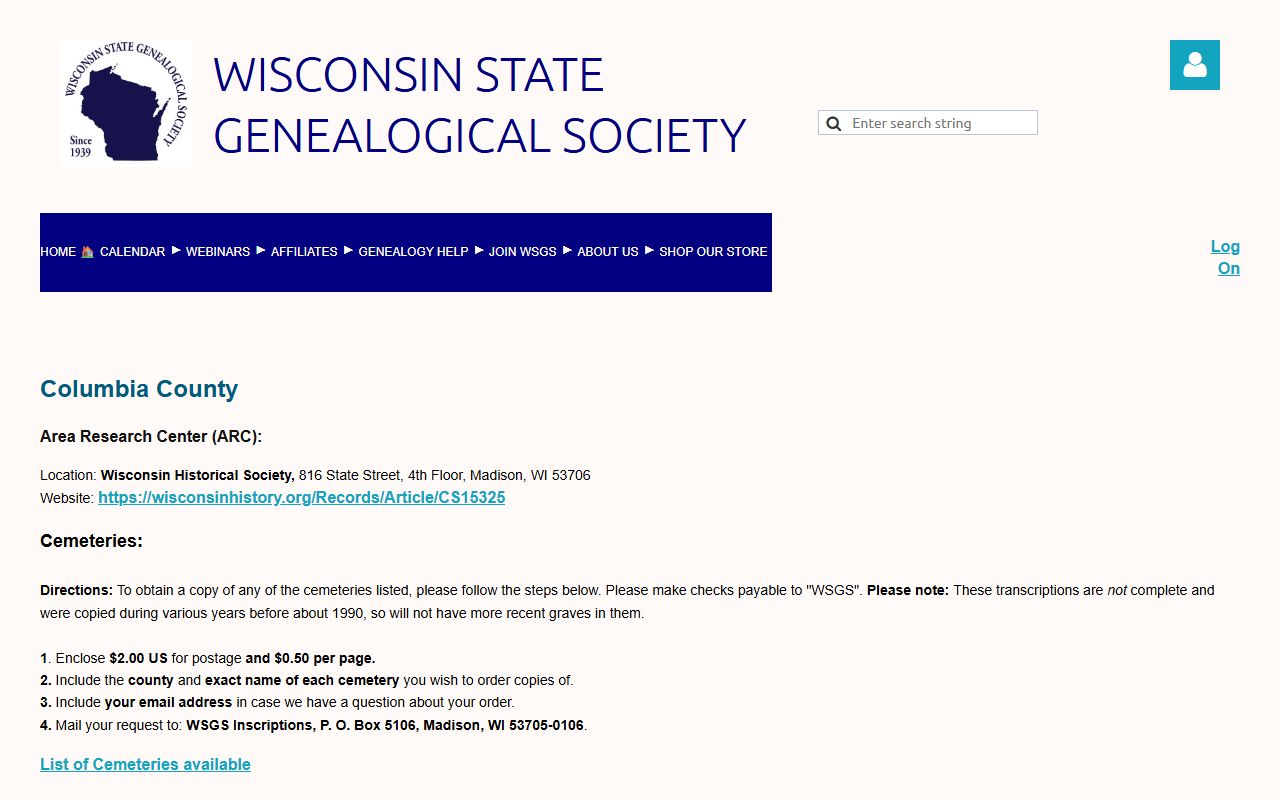
That county guide is a good starting point when you want a local path before you move into state and archive sources.
The Wisconsin Historical Society image in the manifest points to wisconsinhistory.org.
It fits Columbia County because older family material often shows up there after the county record trail starts to thin.
The BadgerLink image in the manifest links to badgerlink.dpi.wi.gov.
BadgerLink is especially useful when you want newspaper access, family history databases, or a second route into a difficult surname.
The Wisconsin State Law Library image in the manifest points to wilawlibrary.gov.
That source is helpful when a Columbia County request needs a clearer read on public access, probate, or record rules.
Columbia County Genealogy Help
The Columbia County Historical Society at columbiacountyhistory.org is listed in the research as a local help point for genealogy work, and that kind of society can be useful when you need town names, family clusters, or a lead on an older cemetery or church line. Even when a county office has the official record, local history groups often hold the small clues that make the record useful. A surname on a page is good. A surname tied to a place is better.
Regional help matters here too. The UW-Green Bay Archives and Area Research Center can support Columbia County records through the broader archive network, which is useful when a family crossed into another county or appears in older court, land, or probate material. That broader frame helps when the county record is clear but still incomplete. It also gives you a place to look for a copy, index, or related file that was never kept in one simple set.
For state-level support, the Wisconsin Historical Society and FamilySearch Wisconsin Genealogy are the strongest broad tools in the research set. Add the Wisconsin State Law Library when you need a clearer read on public access or probate rules, but keep the search grounded in the Wisconsin sources first. National Archives at Chicago and BLM General Land Office Records can help when Columbia County families left a federal paper trail, especially in land or migration work.
Columbia County Record Access
Columbia County access is straightforward once you know the office and the fee structure. The register of deeds office in Portage handles the county copy work, and the fee schedule tells you what to expect before you walk in or send a request. That makes the county good for practical family history research. You can ask for a certified copy when you need proof, or use a real estate document copy when the family story runs through a farm, town lot, or inheritance chain.
It also helps to search in layers. Start with the county office for the record. Then use the historical society for local memory. After that, move to the UW-Green Bay archive network and the state history tools if the family line goes earlier than the county copy or if the spelling shifts from one source to the next. The sequence is simple, but it keeps the work disciplined. Columbia County genealogy usually responds well to that kind of order.
Before you request a record, keep a short checklist in mind:
- Name variants and maiden names.
- Approximate year or date range.
- Town, village, or township clue.
- Whether you need a vital record or a land copy.
That small set of facts is enough to make a Columbia County request more precise. It also helps you decide when the county office is enough and when the archive network is the better next step.
Note: Columbia County often rewards a land-first search because the 1829 record line can point you to a family before the vital records do.