
Brown County Genealogy Search
Brown County genealogy work is rich, but it rewards a steady plan. The county has early vital records, strong local history collections, a deep archive network, and a Register of Deeds office that handles both official records and in-person research rules. If you are trying to place a family in Green Bay, track a marriage line, or connect a farm to a surname, Brown County gives you several ways to move forward. The best searches here use the county office, the local library, and the university archive together, so one clue can confirm the next.
Brown County Genealogy Overview
Brown County Genealogy Records
The Brown County Register of Deeds is the anchor point for Brown County genealogy. It holds birth records from 1846, marriage records from 1821, death records from 1834, and land records from the 1820s. That long run makes Brown one of the best counties in Wisconsin for deep family work. The office is at the Northern Building in Green Bay, and its records can point you from a single name to a full property or family trail.
Use the county office page at Brown County Register of Deeds when you need the official record source. The office notes weekday hours, a phone line, and a specific genealogy research schedule. Genealogy research is by appointment only, and visitors must complete the Application for In-Person Search before they start. That detail matters, because Brown County records are open to careful use, but the office expects the visit to be orderly and focused.
For family research, that office is strongest when you pair it with surname notes from local history collections. A birth entry can identify parents. A marriage record can separate two men with the same surname. A land file can show a move, an heir, or a neighbor who later appears in a city directory. Brown County genealogy gets better each time one record confirms another.
Note: The register of deeds requires photo ID, limits the research room to one user at a time, and does not allow food, drinks, cameras, tablets, or children under 12 in the research area.
Brown County Search Tips
Start Brown County genealogy searches with the office rules in mind. The county asks you to bring a valid photo ID and finish the application before you enter the research area. That sounds simple, but it saves time. Brown also charges $20 for certified or uncertified copies and $7 for a verification of information per record, so you should know whether you need proof, a copy, or just a fact check before you order anything.
The register of deeds page and the Brown County Library Local History and Genealogy Department work well together. If one source gives you a date and the other gives you a place, you can often lock the family into the right line. For a county as busy as Brown, that two-step approach is safer than relying on one index alone. It is also better when the family moved between town and farm more than once.
Here are the most useful things to carry into a Brown County genealogy search:
- Full names with maiden names and known variants
- An approximate year or date range
- A town, ward, township, or cemetery clue
- Any prior owner, spouse, witness, or parent name
If you have those details, Brown County records become much easier to sort. Even small clues can keep you from missing the right person in a large city index.
Brown County Genealogy Library
The Brown County Library Local History and Genealogy Department is one of the strongest public research rooms in the county. It sits on the second floor of the Central Library in Green Bay and keeps more than 10,000 books, Wisconsin vital record indexes, the Green Bay Health Department marriage and death index from 1920 through 1986, census records, cemetery records, plat books, Sanborn maps, city directories, military records, immigration and naturalization sources, passenger lists, family histories, and a large French-Canadian collection. The department also points researchers to HeritageQuest and Fold3 for online work.
Use the library page at Brown County Library Local History and Genealogy Department when you need a place to build a fuller family story. The collection is broad enough to support both a quick check and a long search session. Hours vary by day, which is useful to know before you plan a visit. When a surname appears in a newspaper clipping or cemetery list, the library can help you stretch that clue across several record types.
The first Brown County image in the manifest comes from the Register of Deeds listing at browncountywi.gov/departments/register-of-deeds.
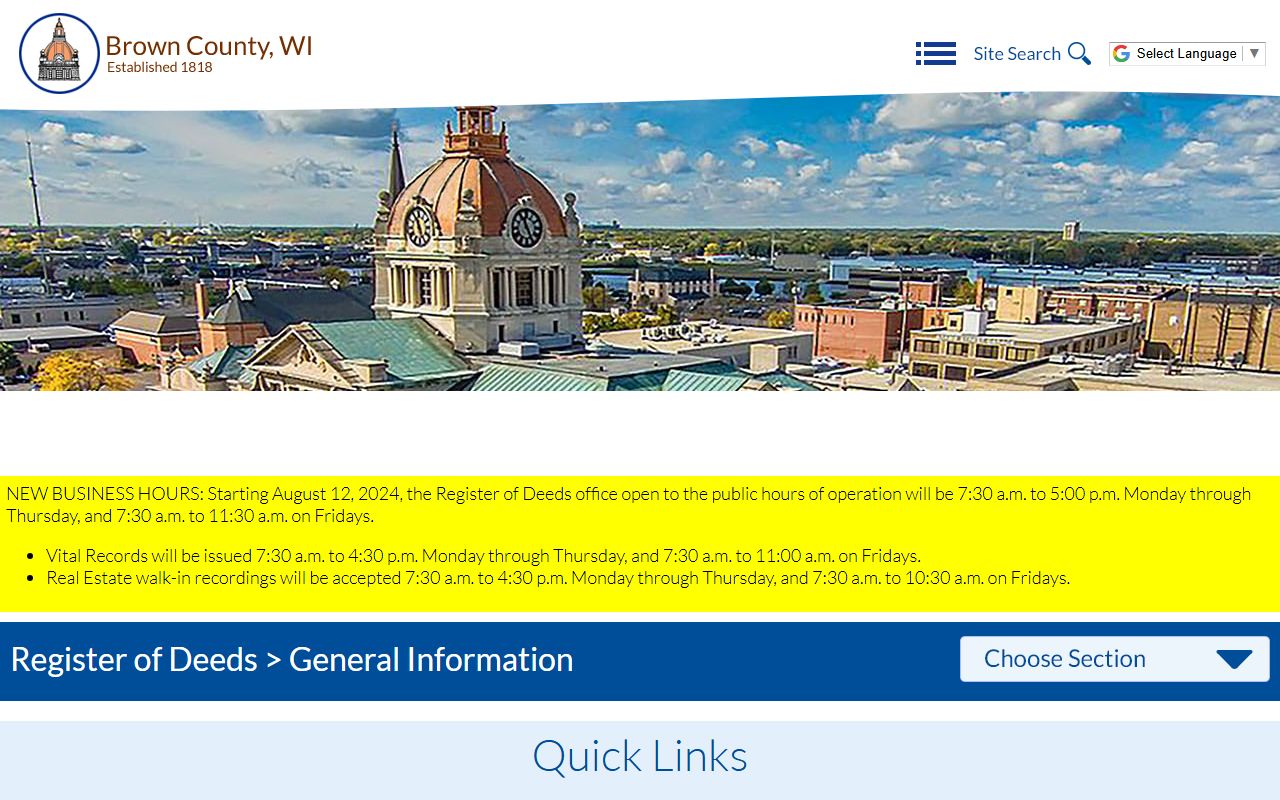
This register image fits the county well because the office is the starting point for vital records, land books, and appointment-based research.
Brown County Genealogy Archives
The UW-Green Bay Archives and Area Research Center gives Brown County genealogy a wider frame. It covers Brown and nearby counties, and it keeps pre-1907 birth, marriage, and death records, citizenship and naturalization files from 1829 to 1984, court records from 1823 to 1939, probate records and wills from 1821 to 1976, land and tax rolls from 1820 to 2005, Belgian pedigree charts, and the Brown County plat map from 1875. That range makes it useful when the family line crosses county borders or begins before modern civil registration.
Visit UW-Green Bay Archives / Area Research Center when you need deep record work. The archive is not just for one county question. It works as a regional net for Brown, Calumet, Door, Florence, Kewaunee, Manitowoc, Marinette, Menominee, Oconto, Outagamie, and Shawano. If a Brown County family also shows up in probate or land records elsewhere, this center can help pull the pieces together.
That regional coverage matters in Green Bay research because many families crossed parish, township, and county lines. A court file or tax roll may point to the same person you saw in a birth index. When that happens, the archive gives the line some depth.
The image below comes from the UW-Green Bay Archives listing in the manifest at uwgb.edu/archives.
The archives image is a good match because this repository is where Brown County genealogy work often turns from a quick lookup into a deeper case file.
Brown County History
The Brown County Historical Society gives the county its local memory. It is useful when you want a family story to sit inside the place where it happened. Church groups, neighborhood names, and older farm clusters often appear in society files long before they show up in a clean index. That is one reason Brown County genealogy can move so quickly once you find the right local contact.
See the society at Brown County Historical Society for local history support. It pairs well with the Wisconsin Historical Society, which holds statewide family resources and older material, and FamilySearch Wisconsin, which helps map out the county record landscape. For newspaper and database access, BadgerLink is another good state-level tool.
The society image in the manifest comes from browncohistoricalsoc.org.
This image works because local history groups often preserve the family details that never make it into a short index entry.
The Brown County Library image in the manifest comes from browncountylibrary.org/local-history-genealogy.
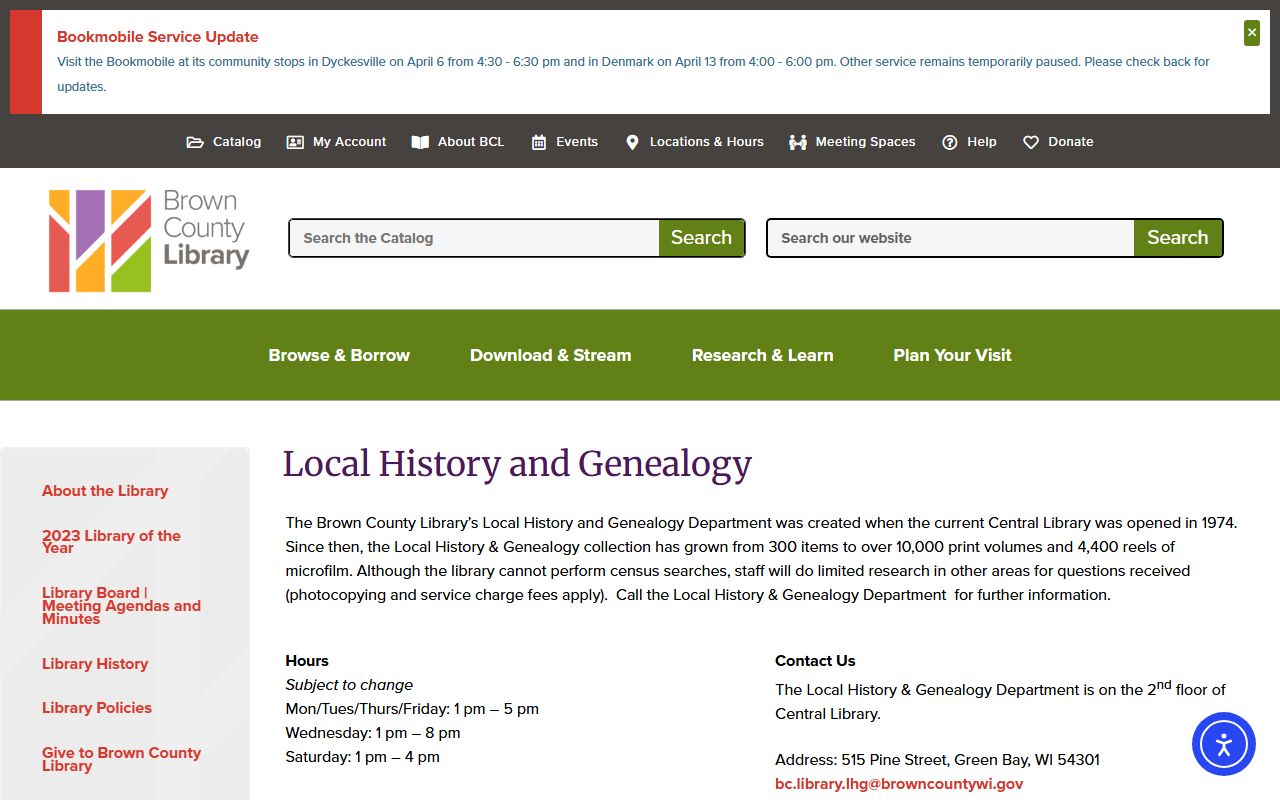
The library image closes the Brown County loop because a strong genealogy search here often moves from the register to the books and then back again.
Note: Brown County genealogy research works best when you combine the register, the library, and the archive instead of stopping at the first record hit.