
Search Milwaukee Genealogy
Milwaukee genealogy research is broad, deep, and easy to branch across several strong local repositories. The city has a large public library genealogy collection, a city vital statistics office, the UWM archives, and the Milwaukee County Historical Society, so one family line can often be checked in more than one place. That matters because Milwaukee families left records in city books, county files, church files, and newspapers. Start with the record type you already know, then move into the local collections that can add names, dates, and family context. The city rewards careful work and gives you enough sources to keep going.
Milwaukee Genealogy Records
The Milwaukee Public Library Genealogy Collection is one of the strongest city genealogy resources in Wisconsin. It sits at Central Library on West Wisconsin Avenue and holds birth records on microfilm from 1854 to 1911, a birth index from 1854 to 1932, marriage certificates from 1822 to 1876, marriage records from 1836 to 1911, and death records from 1852 to 1912 with index coverage in several date blocks. That gives Milwaukee genealogy researchers a real paper trail for early family work. The collection also includes passenger lists, family histories, periodicals, city directories, census records and indexes, Milwaukee Road Archives employee files, MCGS Family Files, an African American Genealogy Pathfinder, and a cemetery records collection.
For research inside the library, the collection is available in the Frank P. Zeidler Humanities Room, and the library also supports online databases within MPL libraries only through Ancestry Institutional Edition. HeritageQuest is available remotely for Wisconsin residents via BadgerLink, and Heritage Hub brings in obituary coverage from the Milwaukee Journal Sentinel, Milwaukee Journal, and Milwaukee Sentinel. That combination makes the library more than a book room. It is a core search point for Milwaukee genealogy because it links indexes, local history, and obituary work in one place.
The City of Milwaukee Health Department Office of Vital Statistics adds another record path. It keeps birth records dating back to 1893 and death records dating back to 1869, but it does not hold marriage or divorce records for Milwaukee County. That distinction matters. A city researcher can use the health office for a birth or death copy, then move to the library or county level for a marriage line. For city work, that clear separation of duties keeps the search efficient and avoids the wrong request in the wrong office.
Note: Milwaukee genealogy is strongest when you use the city library, city vital statistics, and county or archive sources together instead of expecting one office to hold every record type.
Milwaukee Genealogy Search Tips
Start with the most exact clue you have. If you know a birth or death date, the city vital statistics office is a good place to confirm it. If you need a marriage or a fuller family trail, the public library is usually the better first stop. Milwaukee genealogy works best when you know which office fits the record type before you begin. That saves time and reduces duplicate requests.
The UWM Libraries Archives add a different layer. The archive holds the General Birth Index for Milwaukee County from 1823 to 1932, registers of births, delayed birth registrations, marriage certificates, marriage indexes, death indexes, death registers, naturalization records, church and cemetery records, and Milwaukee City Directories. That is a major source for family lines that move through church, neighborhood, and immigrant records. It can also support research for nearby counties because its coverage reaches beyond Milwaukee itself.
Before you search Milwaukee genealogy, bring these details:
- Exact names and alternate spellings
- A year or short date range
- A neighborhood, ward, church, or cemetery clue
- The record type you need first
Those details make the city repositories much easier to use. They also help you move from one collection to the next without losing the thread.
Milwaukee Genealogy Images
The manifest links the Milwaukee Public Library image to the library genealogy collection page, which is one of the most important Milwaukee research sources.
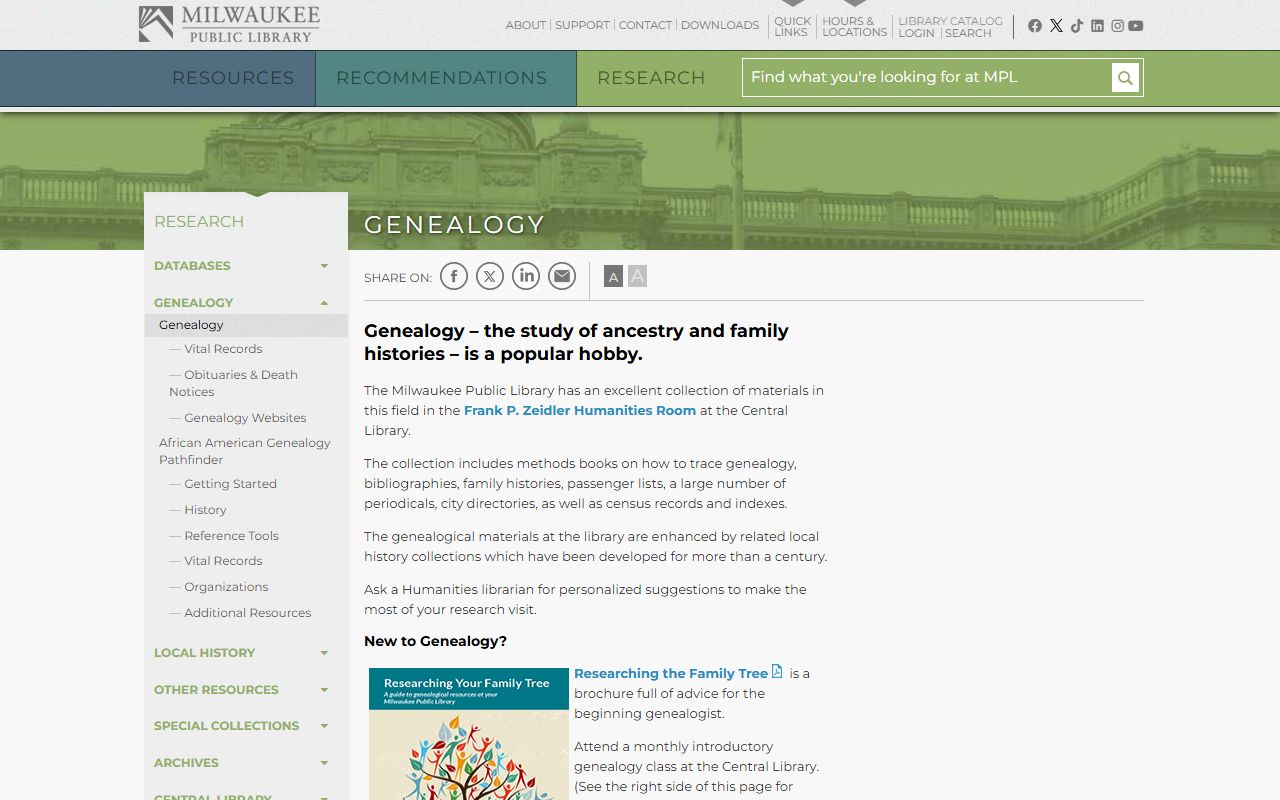
This image fits Milwaukee because the library is one of the city’s main entry points for family history work.
The state fallback image links to wisconsinhistory.org, which is the best broad backup for older Wisconsin family history.
It belongs here because Milwaukee families often need statewide index and pre-1907 support after the city collections have done the first pass.
Milwaukee Genealogy Help
The Milwaukee County Historical Society adds a strong local history layer. It holds naturalization records, city directories, Sanborn maps, plat maps, and Civil War military records, which are useful when a family line needs more than a certificate. That kind of material helps explain where a family lived, what neighborhood it belonged to, and how it fit into the wider city. For Milwaukee genealogy, that local context matters as much as the official record.
The UWM Libraries Archives also deserve a close look because they hold not only genealogy-friendly indexes but also church and cemetery records, Milwaukee City Directories, and regional naturalization records. Their coverage of Milwaukee, Ozaukee, Sheboygan, Washington, and Waukesha counties makes them useful for city families whose paper trail crosses county borders. When a family moves through the region, the archive can still keep the line together.
For broader support, use the Wisconsin Historical Society, BadgerLink, Wisconsin State Genealogical Society, National Archives at Chicago, and BLM General Land Office Records. Those sources are especially useful when a Milwaukee line reaches into older state, newspaper, or federal material. They do not replace the city repositories. They widen the search after the city sources have done the first work.
Milwaukee Genealogy Access
Milwaukee genealogy access is practical because the city offers several different entry points. If you need a birth or death copy, the health department office is the right city stop. If you need a marriage or broader family-history trail, the public library and archive collections are better choices. If you need neighborhood context or naturalization work, the historical society can help. That makes the city a good place for layered research.
The city collections are especially useful because they support both quick lookups and deeper family work. A birth index can point to the right household. A city directory can place the family in a ward. A cemetery file can close the line. When you use Milwaukee genealogy in that order, the search gets clearer as it moves from one source to the next.
Keep these items ready before you search:
- Exact names and common spelling shifts
- A target year or short date span
- A neighborhood, ward, church, or cemetery clue
- Whether you need a city vital record, a county record, or an archive file
A narrow request works best in Milwaukee because the city collections are large enough to reward precise questions.
Note: Milwaukee genealogy often works fastest when the public library and UWM archives are used as the main research engines, with the city vital office as the record-check step.
Milwaukee Genealogy Next Steps
Begin with the city source that matches your clue. Use the health department for a birth or death copy. Use the public library when you need microfilm, directories, census material, or obituary work. Use the UWM archives when you need naturalization, church, cemetery, or city directory depth. Then add the historical society if the family story needs maps, land context, or military records.
Milwaukee genealogy works best when you think in layers rather than in one stop. The city has enough records to support that approach, and the different repositories complement each other well. One source gives you the date. Another gives you the place. A third gives you the family pattern. That is usually enough to turn a name into a documented city line.