
Search Appleton Genealogy
Appleton genealogy research is strong because the city has a public library, a FamilySearch Center, and an easy county record connection. The Appleton Public Library offers one-on-one genealogy help, city directories, local histories, newspaper articles, and a Post-Crescent obituary index, while the FamilySearch Center gives researchers free access to computers and restricted historical record images. The Outagamie County Register of Deeds adds the official birth, death, and marriage record trail. That combination makes Appleton a city where a family line can move from a city directory to a certificate without losing the thread.
Appleton Genealogy Records
The main city research stop is Appleton Public Library Genealogy & Local History at 200 N. Appleton St., Appleton, WI 54911. Call 920-832-6173 or email askus@apl.org. The library offers one-on-one genealogy help and is a FamilySearch Affiliate Library. Its research access includes Wisconsin Historical Society family history records via BadgerLink, census records, birth, marriage, death, immigration, military, city directories, local histories, and newspaper articles. For Appleton Genealogy, that is a broad and practical local source set.
The library’s special collections make the city page especially useful. It holds the History of Outagamie County, Pioneers of Outagamie County, and Land of the Fox, Saga of Outagamie County. It also keeps Appleton city directories for 1874, 1930, 1980-1984, and 1993, plus an index to obituaries from the Appleton Post-Crescent for 1936-1971. Church records are part of the source set as well, including First Congregational Church records, First United Methodist Church baptisms and marriages, and St. John United Church of Christ records. That mix helps Appleton Genealogy researchers move from a name to a place, a date, and a congregation.
The Appleton Wisconsin FamilySearch Center is another strong local tool. It provides one-on-one assistance from knowledgeable volunteers, free access to computers and subscription family history websites, and access to images of historical records that are only available in centers. That can be useful when a family clue is in a restricted image or when you need a second set of eyes on a record. The Outagamie County Register of Deeds at 410 S. Walnut Street in Appleton also matters because it holds birth, death, and marriage records from 1852. Together, these city and county resources make Appleton Genealogy more complete than a single source search.
Appleton Genealogy Images
The Appleton FamilySearch Center image points to one of the city’s best hands-on genealogy supports.
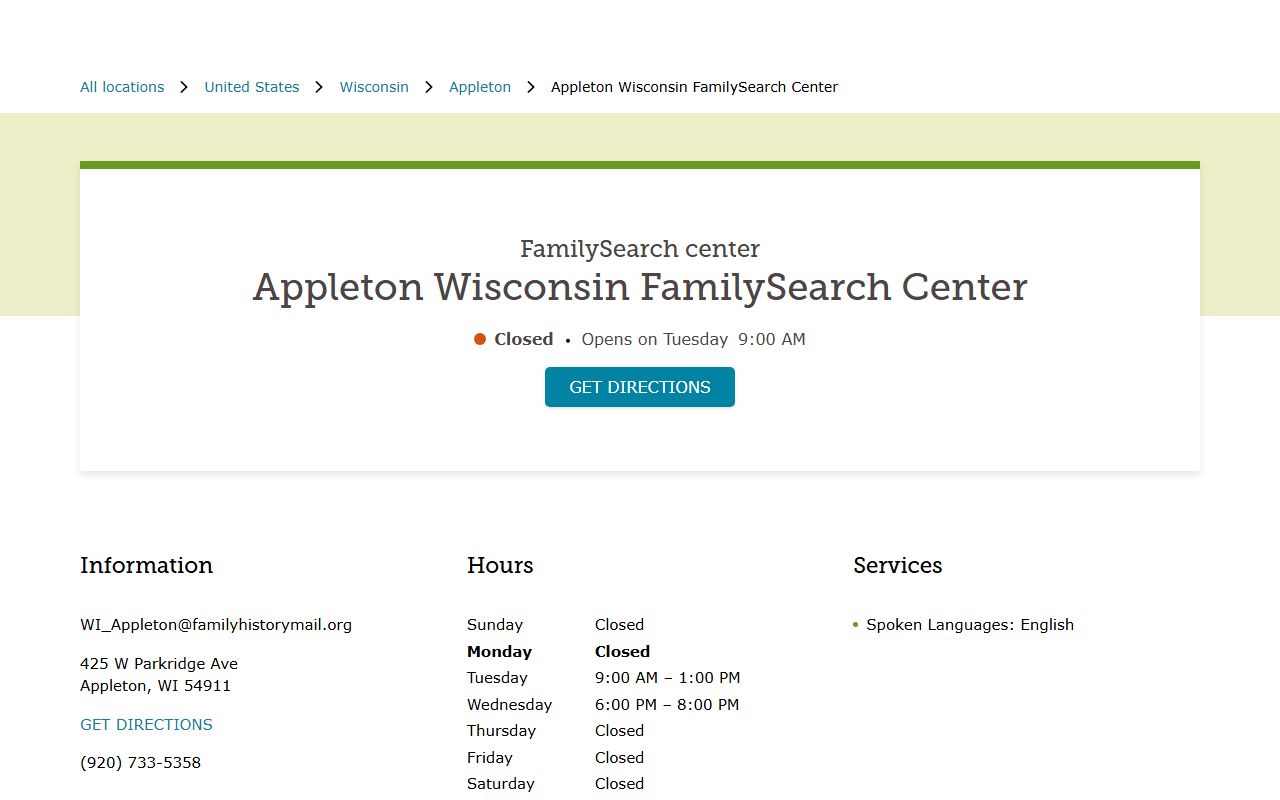
This image fits Appleton Genealogy because the center provides volunteer help, subscription website access, and historical record images that are hard to get elsewhere.
The Wisconsin Historical Society image gives Appleton a strong state-level backstop for older records and pre-1907 family history work.
That image belongs here because Appleton researchers often need a statewide record check after they start at the library or FamilySearch Center.
The BadgerLink image ties Appleton Genealogy to the Wisconsin Historical Society family history records available through the state partnership.
It is a natural fit because the library already points researchers to those Wisconsin family history tools.
Appleton Genealogy Help
The Appleton Public Library is the city’s main help desk for genealogy because its staff can provide one-on-one assistance. That matters when a search turns up several names with the same surname or when a family appears in a city directory but not yet in a vital record. The library’s mix of census records, local histories, newspaper articles, and obituary indexes makes it easier to build a timeline before you ever request a certified copy. Appleton Genealogy often becomes clearer after a single library visit.
The Appleton FamilySearch Center adds another layer of help. Volunteers can walk you through the search process, and the center offers access to subscription family history websites and record images that are only available in a center setting. That is useful when you need to compare records or when a family line sits behind a subscription barrier. Because Appleton has both the library and the center, researchers can move between public material and more specialized search tools without leaving the city.
The Outagamie County Register of Deeds is the city’s official record connection. Birth, death, and marriage records begin in 1852, so the office is important whenever a family line reaches into the mid-nineteenth century or later. Even though the office is a county source, it belongs in any Appleton search because the city and county record trails are closely tied. A city family often appears first in a directory, then in a church record, and finally in the county certificate file.
For an even wider Wisconsin frame, the Wisconsin State Genealogical Society and Wisconsin Historical Society are both worth using. The society side of the work helps when a family line needs a county-by-county research hint or an older state record check. That makes Appleton Genealogy stronger because the city resources and the statewide collections reinforce each other.
Appleton Genealogy Search Tips
Appleton Genealogy searches work best when you start with the source that matches the clue. If the clue comes from a newspaper, the library’s obituary index or local paper collection may be the fastest path. If the clue is a baptism or marriage, the church records and FamilySearch Center may help first. If the clue is a birth or marriage date, the Outagamie County Register of Deeds should be in the plan from the start. The city has enough options that you can usually choose the right doorway before you begin.
City directories are especially useful in Appleton because they appear across several years in the library’s special collections. They can show a move, a trade, or a household change long before the record reaches a county file. The Appleton Post-Crescent obituary index can then confirm a death date or help you identify relatives. Appleton Genealogy gets much easier when you use those sources together instead of one at a time.
Bring these details with you:
- Exact names and common variants
- A year or short date range
- A street, church, business, or school clue
- A likely record type such as obituary, directory, birth, marriage, or death
That keeps the search focused and helps the library, center, or county office give you the right answer faster. Appleton Genealogy rewards a good starting point because the city has enough records to make a narrow search pay off.
Wisconsin Genealogy Support
When Appleton Genealogy needs wider support, the BadgerLink portal is one of the best tools because it ties the library’s research path to Wisconsin Historical Society family history records. That makes it easier to move from a city directory or obituary index into statewide vital and probate material. The Wisconsin Historical Society remains the best place for pre-1907 records and broader historical collections, especially when an Appleton family line predates the county copy you need.
The Wisconsin Circuit Court Access site is useful if the city story extends into a later court case. The National Archives at Chicago helps when a family leaves federal traces in military or naturalization records. And the Wisconsin State Genealogical Society can point you toward county-level research ideas when the Appleton trail gets wide. Those are support tools, not replacements for the city sources, but they keep the search moving when the local file is not enough.
Appleton Genealogy works best when the city library, FamilySearch Center, county register, and state sources are all used in the right order.